 KOMY Phone
A friend who needs your help.
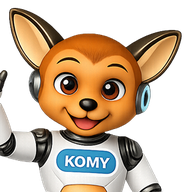
Most learning apps ask questions they already know the answer to. Komy doesn’t. He is the friend who has forgotten something, wonders and gets stuck – and your child is the one who helps him.
Good to know: Komy speaks German. Voice, stories, encyclopedia, learning games and the parents’ app are in German; contract language and legal texts are German as well.
The one inversion
Komy is the one who needs help. He asks your child about exactly what the child is learning right now – not as a test, but because he no longer knows it himself. A child who explains something to a friend feels strong. A child who is quizzed feels measured. Same subject matter, opposite effect; the difference lies in the role alone. That role is the product.
What Komy never does
- give the solution, the word, the number or the explanation
- correct, mark anything right or wrong, grade, test or quiz
- guilt-trip, compare or mention what your child did not do
- invent things about your child’s school, family or life
- promise secrecy or play therapist, doctor or a substitute for a trusted adult
What Komy always does
- steer so that your child gets there alone: wonder aloud, ask, tell what he tried, take only the first small step
- praise the trying, never the result
- invite – and cope when your child turns the invitation down, without consequences
- stay inside your child’s real everyday life: timetable, appointments, yesterday’s book
- gently point to a trusted adult when something is serious
Where Komy gets his material
Everything Komy brings up comes from your child’s real week and is assembled on the phone: the timetable (photographed once by you), appointments and chores, the learning games, the reading sessions with the memory book, and the Magic Sky with the moments worth celebrating. What Komy brings up today is decided by simple arithmetic over these signals – a single difficult day never changes a verdict, because there is no verdict.
Two Komys, a voice made of building blocks
At the first meeting your child picks one of the two Komys and gives him a name. From then on Komy speaks with his own voice. It is synthetic; his sentences were written in advance, checked by a human and stored on the phone as audio – a hundred stories, a whole vocabulary, a thousand first names. No language model and no chatbot runs on the phone; Komy works offline too. What your child tells him is not recorded.
The encyclopedia belongs to the child, not to Komy
The KOMY Phone holds a whole children’s encyclopedia to browse. Komy never reads from it and never answers with it – it is your child’s own book. Komy stays the friend who asks and marvels; looking things up is what the child does. That keeps the roles clear: knowledge comes from a checked encyclopedia, not from a character that makes up answers.
What you see as parents
Joy and safety: the books read, the chores done, the arrival at a safe place. Never the confidential talks between child and Komy, never Komy’s inner state, never an assessment of the child. Friendship needs a protected space – from us as well.
Try Komy’s voice on the start page: Say something, Komy and Komy tells a story (both in German).